Friday, April 29, 2011

Jamón Hijinks


For awhile now, I’ve wanted to learn more about jamón iberico (which I’ll call jamón for short), I guess since the time I started thinking of it as a kitchen staple.  I considered asking Henrik, our charcuterie guy, if he would let me volunteer behind his counter at the market.  But I realized I would, at the least, be more of a nuisance than a help.  And I also have a healthy fear of deli slicing machines.  I am rather accident-prone, so I see this as a self-preservation instinct.

A few months ago I found myself shopping at the market on a slow day, and I asked Henrik a few questions about jamón. 

“Would you ever consider doing some kind of tasting for Alec and me some time?” I asked. 

Henrik colored deeply.  “Well,” he said, “it’s just that I’m here almost all the time, and then I’m really tired at the end of the day…”  He turned around and started rooting through some papers on the back of his counter.  After a few minutes he pulled out a pamphlet called “Jamón.”

“You can borrow this,” he said, handing it over the counter.  “It will tell you everything you need to know.  But it’s the only one I have so please take care of it and make sure to bring it back.”

“Okay, thanks.  Thanks a lot,” I said.  But I must have looked a little disappointed.

“Look,” Henrik said.  “Come by some day when it’s not too busy—maybe a Tuesday—and we can get a coffee and talk about jamón.”

“That would be terrific.”

But I haven’t taken him up on his offer yet.  I guess I don’t want to put him out.  And I still have to bring back the jamón pamphlet. 

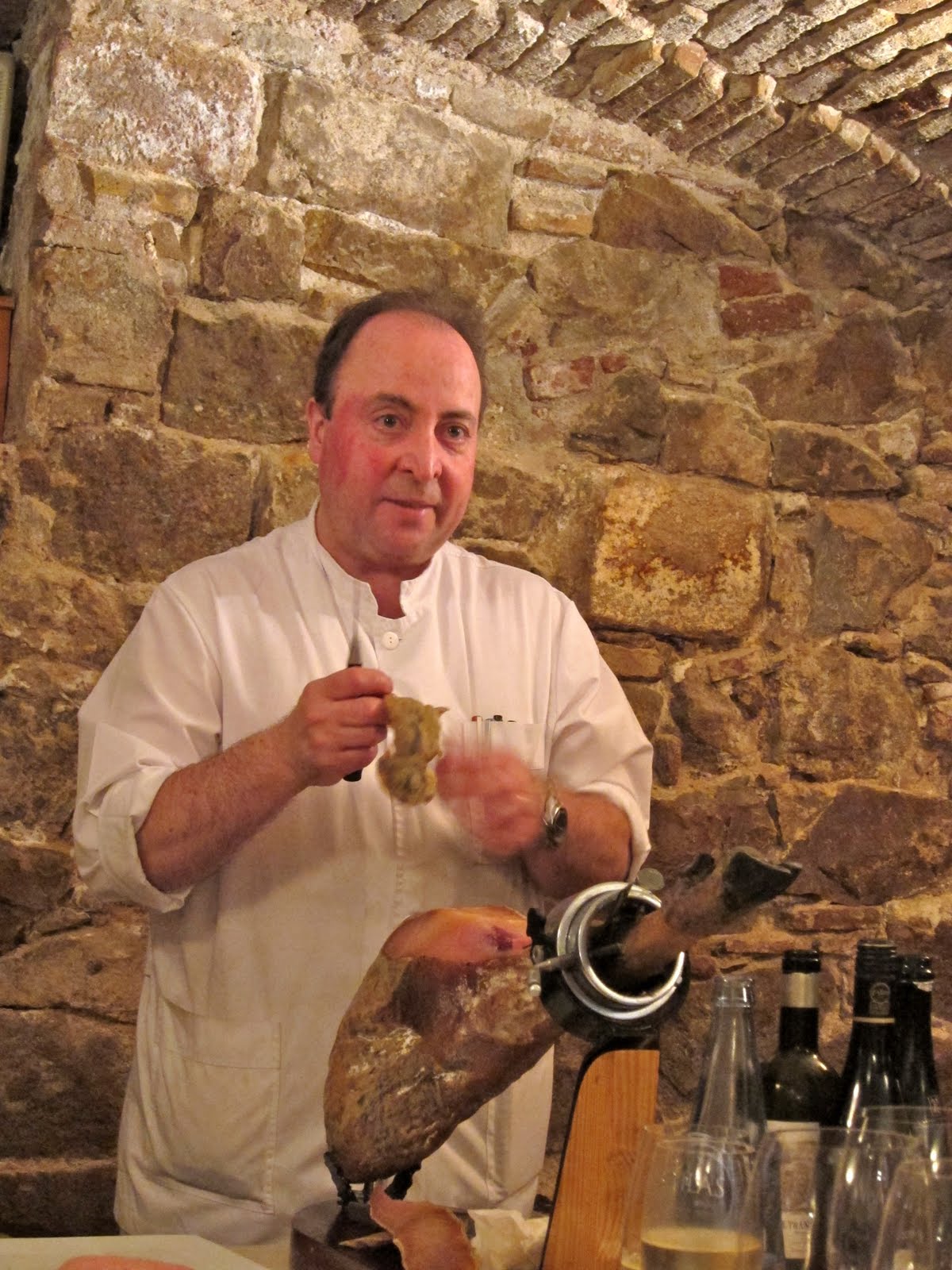
But when I saw a jamón tasting advertised on the Vila Viniteca website, I jumped at the opportunity.  Yesterday was the big day.  Vila Viniteca has a lovely old stone room below the main store where they hold tastings.  It holds a table for twelve and is lined with racks of wine bottles.  I arrived yesterday and saw Marta, the founder’s granddaughter, who recognized me from when Alec and I interviewed her.  She kissed me on both cheeks, told me the tasting wasn’t quite set up yet, and handed me a glass of cava to sip on while I waited.

The tasting, called for 2 pm, didn’t start until after 2:30, a reminder that I’ve returned from Germany.  In addition to Antonio, who I will call the Jamón Master, and the sommelier, there were five of us:  two businessmen in their 50s from Granada, a silent Finn, and a heavily tattooed guy with a David Villa haircut and his arm in a sling.  And me.

Antonio spent about a half hour telling us about where the pigs came from originally (all over northern Europe but they stayed in Spain because they really liked the acorns and so were “super contenta”), the importance of the pigs’ diet, the different grades of jamón (jamón iberioa de bellota (bellota means acorn) is the best, and most expensive).

But what fascinated me was to learn about all of the tricks people play in order to try and pass off fake jamón iberico for the real thing.

Trick #1:  Authentic jamón has a rich nutty taste—you can actually tell that the pig you are eating feasted on acorns for much of its life.  Apparently, some jamón scheisters feed their pigs commercial food, and then inject them with acorn oil to infuse the meat with that flavor.

Trick #2:  A true jamón iberico does not have hairy legs.   When you see it in the deli, there should be no hair on its slender little ankles (and, yes, these particular porkers are known for their long, thin ankles).  One way to trick folks is to burn the hair off before the meat goes to market.

Trick # 3:  This is my favorite.  Real jamón iberico is flecked with small white specks along the fat lines—it’s a substance called tiroxina (I’m not sure how you translate this), and it’s one way to tell that you’ve got the real deal.  Again, it’s a result of the pigs’ diet.  But there is another way to produce these little white crystals.  Apparently, pigs’ preferred position is to be standing upright.  If you knock them down, they will get up again.  And if they get knocked down and then right themselves repeatedly, they make tiroxeina.  So the ham bad guys will actually load up the back of a truck with a bunch of regular, non-iberico pigs and drive them around on curvy roads long enough for the pigs to topple over and get up, creating the specks.  But the pigs have not had the acorn diet.  And getting knocked down in the back of a truck over and over makes for one stressed-out pig, which makes the meat tough. 

So if you ever find yourself driving around Spain and end up behind a truck full of pigs on a mountainous road, you will know what’s going on.  Buyer beware.

PS  I’m pretty sure all of the above is correct, but the tasting was completely in Spanish, so I take full responsibility for any errors, which no doubt result from my poor translation skills.

PPS  The jamon was outstanding.

Photos of the Day


Thursday, April 28, 2011

El Clasico #4


When my Spanish teacher, Sylvia, showed up yesterday morning, I told her I had abandoned the novel she had suggested I read for the past few days and had switched to the newspaper.  I told her I was “leyendo el hype.”  When I don’t know how to translate a given word in Spanish, I often just throw out the English word.  Sometimes it actually works. 

“What is hype?”  she asked.

“Es lo que escriben las periodistas en avance de un gran partido,” I said.—It’s what the journalists write in the lead up to a big game.

There is nothing like the hype leading up to El Clasico.   Now that I think about it, I’m not sure how they can continue to call it El Classico, when last night’s was the fourth this year.  Shouldn’t it be Los Clasicos?

Anyway, I suppose that’s beside the point.  What is noteworthy is that Barça Fever seems to have snuck up on me and taken hold. I started out the year watching the team as a way to forge another connection point with my husband and son and also from the perspective of a sociologist, given how far-reaching the Fever is here. I now watch because I enjoy it.  I have been drawn into the drama, the stories, the personalities, even the rules of European futbol.

It’s not as though I’ve never been a sports fan.  My dad was a basketball coach, so I grew up with televised sports as the soundtrack of my childhood, and I hurried back  from my own doctoral graduation to watch the Knicks play in the NBA finals at my neighbor Larry Dunnigan’s house.  But it’s been a long time since I really got into a team, since I actually cared.

I often struggle to make myself read another depressing story about the economy in the newspaper. I tell myself I should read that first, and then reward myself with the dirt on Barça.  But usually the part of me that says, “It’s all in Spanish, so read whatever the hell you want,” wins out.   So on any given day I may know more about the status of Carles Puyol’s knee injury than I do about the state of the euro. C’est la vie.

Last night’s game was a real barnburner.  Before I tell you what happened, I have to give you the bare minimum in terms of context.  Okay, here goes.  Last night, Barça and Madrid played each other to determine which team will go to the finals of the Champions League tournament, to be played in Wembley Stadium on May 28.  But the interesting thing is that the semifinal is really two games, not one.  One game is played on each team’s home field—it’s called an “ida y vuelta,” which translates to “round trip.”  So it’s as though each game constitutes one half of the semifinal.  And in terms of scoring, a goal scored on one’s opponent’s field counts for more than a goal scored on one’s own field.  So, for example, Barca could lose the game on its home field (0 – 1) and win the game at Madrid (2 – 1).  Even though each team scored 2 goals, Barca would go to the finals because its two goals were scored on the other team’s field, whereas only one of Madrid’s was scored away.  If the number and kind of goals add up to a tie at the end of regulation time in the second game, they go to overtime, playing an 30 minute period.  If it’s still a tie, they go to penalty kicks.  (Honestly, I’m not sure where this information is being stored in my brain, since it’s harder every day for me to find my phone and keys.  I think it’s in the same place as all of those Top 40 song lyrics and commercial jingles from the 1970s).

Last night’s game took place at Santiago Bernabéu stadium, Real Madrid’s field.  Barça would have been happy to have come away with a tie.  In the second half,  Pepe, Real Madrid’s meat cleaver of a midfielder, was red carded, meaning that Real Madrid would have to play the remainder of the game with 10 players instead of 11.  RM is known for playing a very aggressive (some would say dirty) style of soccer, whereas Barça’s style, associated with Johan Cruyff who coached the team in the late 1980s and 1990s is known as “the beautiful game.”  (I prefer the onomatopeic “tiki-taka” to describe Barça’s style of play, which Wikipedia describes as a style  “characterised by short passing and movement, working the ball through various channels, and maintaining possession.”)

In the melee that ensued following the red card, Real Madrid’s coach, Mourinho, was also kicked off the field, and had to watch the remainder of the game from the stands.  Mourinho’s hysteria is the antithesis of Barça coach Pep Guardiola’s cool; if Guardiola is Coach K, Mourinho is Bobby Knight times 10.

With only ten players to face, Barça seized the opportunity not once but twice.  Messi scored both, the first scored in the 77th minute on an assist by Afellay, and the second during the 86th minute, a brilliant run through a slalom course of opponents ending with a patented Messi-style, perfectly placed pop into the net.

So the schoolyard at BFIS, and the streets of the city, were full of people wearing their Barça regalia today.  No other team has come back from the position Real Madrid is in to win but, as my dad always said, “The game isn’t over ‘til it’s over.”  Stay tuned.

Tuesday, April 26, 2011

Can I have a do-over?


My first real day back started off well.  A good workout and yoga, a breakthrough at the office convincing folks in Bigastro and Pals (two of Spain’s slow cities) to allow Sarah and me visit, conduct some interviews and poke around, a clara with my brother-in-law, Rich (who I had just picked up at the airport) at the Mirador de la Venta overlooking the city.  And then things went way south.  I got into a freaky but, as it turns out, not serious accident that scared the bejeezus out of me and left the passenger side door with a big dent in it.  Luckily everyone is okay.  And I felt fine until I parked the car near the kids’ school and realized my hands were shaking so much I could barely turn the key in the car door to lock it.

And then, just as we were approaching home, C.C. announced that she had to puke.  “Hang in there, honey!” I said, passing her a ziploc bag.  She was not able to hang in there, but at least I got her the bag in time.

I got home, poured myself a glass of wine, and focused on dinner, homework, and bedtime.  And now, all I can muster is the energy to take to the bath, and then to my bed.  Tomorrow is another day.

Monday, April 25, 2011

Five Years Gone


To revisit my laundry ranting from the other day, it’s only fair to note that there is a downside to European practicality.  An anecdote, in this case, is worth much more than my own musings.  Saturday morning, we enter the U bahn to head out for the day. We find seats on the train.  An overpowering scent of body odor hangs in the air.  Milo lifts his nose to sniff and then asks, loudly: 

“Hey, what’s that stinky smell in here?”  I look down at my lap trying to suppress my giggles. 

Milo still wants to know.  “What is that smell, Mama?”

I whisper to him:  “Shhh.  I think someone in here needs to take a shower.”

He sticks his nose into Alec’s armpit.  “It’s not Daddy,” he announces to the whole train.  “His hee-hees smell clean and fresh.”

At this point I have dissolved into a puddle of quiet laughter.

“What’s so funny, Mama?” Milo asks, as Alec shushes him again.  Fortunately, our stop is next, and we disembark without further incident.

We’ve found that when we travel for an extended period with the kids—say a week or so—it’s good to give them a complete day of rest.  They love nothing more than to stay in their pajamas all day.  I understand.  Figuring that everything would be closed and that we could use some time to straighten up and pack, we promised them Easter Sunday as the do-nothing day.  But then I saw a sign in the neighborhood for an Easter egg hunt in Viktoria Park, near our apartment, and we gave them the option to go to that.  Of course, they took us up on it.

We made a couple of wrong turns on the way to the park and arrived a bit after the hunt had started.  I had confidence that my New York City-bred, afikomen hunting children would quickly get in the mix and out-hunt the locals, but they were outmatched.  The Germans had shown up with serious baskets, many of which were already full.  C.C. and Milo lacked home park advantage, so after awhile Alec planted some sweets in the bushes for them to find.   There was a nice community vibe—colorful pennants flying, an organ grinder making music (with a stuffed monkey perched atop his grinder thing), and some vendors selling cold drinks and fat pretzels. 

Once the kids’ hunting desires had been sated, we made our way home through the park, which had begun to fill up with Germans baring their milky white skins for the first time after a long, cold winter.  Some of them took the summer-like weather quite seriously; a pair of young women sat topless on their beach towels, for example.  It didn’t take long for a young man with a large video camera and microphone to approach them.  Milo:  “Mama, why does that woman have earrings in her chi-chis?” (Chi-chi is the Mexican slang for “breasts”). 

Once home, Alec fixed our Easter dinner made from market fixings, and we skyped Jody, Matt and Zadie and, later, Lois, Blanca, Leslie and Joe.  It felt good to be connected to home. 

I ran out to try to make a yoga class around the corner, but got there 15 minutes late and was not able talk my way in.  Germans seem to be more strict about these things than the Spanish and, as a chronically punctual person myself, it was interesting to note how comfortable I was showing up late.  I suppose 8 months in Spain has had its effect on my inner clock.

Itching for some exercise, I stopped back home and grabbed by iPod and headphones and headed back to the park for a brisk walk.  I put on the new Adele album I had downloaded and not yet listened to, and when I got to the track To Make You Feel My Love, my eyes welled with tears.  April 24 is the anniversary of my dad’s death four months after his diagnosis with pancreatic cancer, a swift and brutal killer.  It’s been five years and I had been thinking about him more than usual all week.  My dad really liked Norah Jones and Diana Krall, and some of my best memories from the last years of his life were taking him to their concerts.  When I was quite pregnant with C.C., we went to see Norah Jones at the Garden State Arts Center.  My dad insisted that we leave insanely early, as was his custom, and we were among the first to get to the parking lot. We had stopped for sandwiches and other treats at Piancone’s and sat there on a bench eating and talking some, but not much—my dad was not a big talker. He taught his girls to be tough and he impressed upon us the importance of street smarts, so it was nice to have him be so protective of me in my enlarged state.  It was a beautiful night.  He would have loved Adele’s version of this song.  The video is a bit cheesy, but I’m attaching it anyway, along with one of my favorite photos of my dad.  I miss him a lot.

Photo of the Day


Sunday, April 24, 2011

Sergio Ramos Drops the Cup


When I went to bed the other night, Real Madrid was playing Barca for the Copa del Rey.  We couldn’t get the game on TV here, and Alec had gone to watch it at a sports bar across the street which turned out to actually be a betting hall.  Turkish men kept asking him to place bets the whole time he was there.  Alec texted me that, at the end of regular time, the score was 0 – 0.  In a normal game, that would be it.  Tie score.  But since it was a championship game, the game went into extra time. And in the 103rd minute, Cristiano Ronaldo headed the ball into the goal to make it 1 – 0 Real Madrid.  And that’s how the game ended.

Now, Barca and Madrid are playing each other an unprecedented number of times over a couple of weeks to decide three championships.  Barca fans would argue that the Copa del Rey was the least important of these; in fact, Pep Guardiola, Barca’s coach, long ago announced that he would play Barca’s second string goalie, Pinto, throughout that series, a clear indication that it was not his top priority.

However, a win is a win, and Real Madrid played extremely well.  What’s ironic is what happened after the game.  As the team celebrated, riding through the streets on the top of a bus surrounded by cheering fans, Sergio Ramos (my personal favorite Real Madrid player) dropped the championship cup.  He literally dropped the 15 kilo cup from the top of the bus to the ground.  The bus driver did not see it . . . and ran over it, crushing the cup.  Check out this video footage.

Apparently, the silversmith who makes the cup always makes a backup—go figure.  So he drove the cup to Madrid and they quickly had a replacement.  But you have to admit, after all those years without the trophy, it’s pretty funny.